Where should settlements go on invoices?
If you have any finance settlements that need to be cleared on a part exchange, these should be added to the deal in the 'Adjustments' section so they are reflected on the invoice.
Scenario 1: Part Exchange With No Negative Equity
Use this method when the part exchange value is equal to or greater than the finance settlement.
- Add the part exchange vehicle to the invoice.
- Enter the purchase price for the part exchange.
- Add the finance settlement amount that needs to be cleared as an adjustment.
- Ensure the adjustment is entered as a '+' (positive) value.
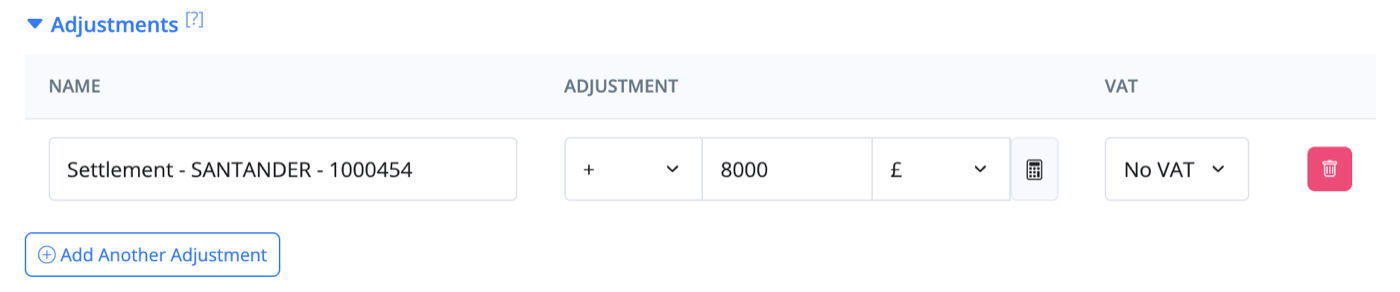
The settlement amount will then be included in the invoice totals, showing the finance being cleared against the part exchange.
Scenario 2: Part Exchange With Negative Equity
When the finance settlement is higher than the part exchange value - you can show this in 2 ways, subject to funder requirements.
Method 1:
- Add the part exchange vehicle to the invoice.
- Enter the correct purchase price for the vehicle.
- Enter the full finance settlement amount as a “+” value.
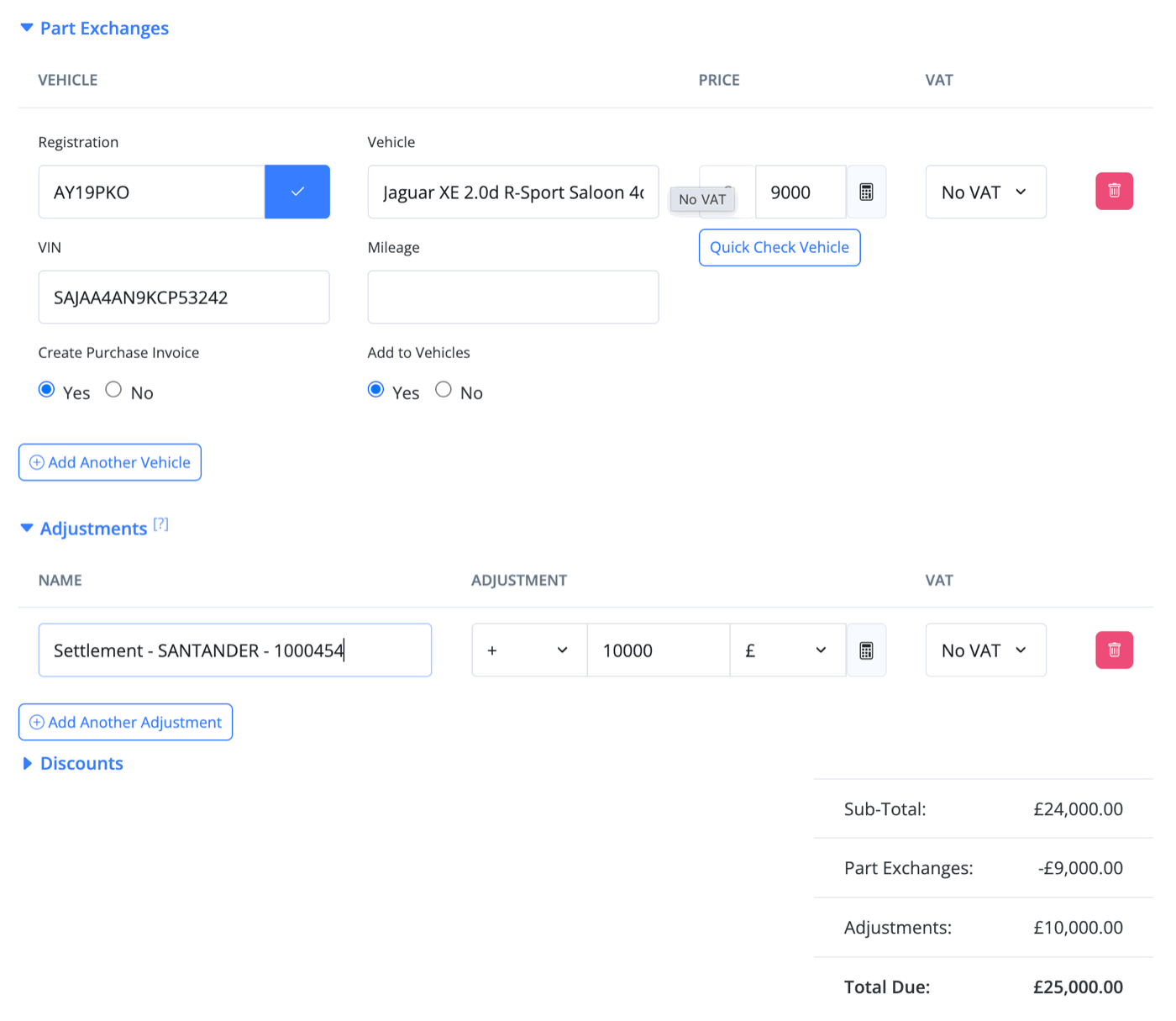
The difference between the part exchange value and the settlement amount will be treated as negative equity and will be added to the invoice total.
Method 2:
If the funder won't fund the negative equity on the deal and the customer isn't putting in a deposit to clear it, meaning you need to to show it separately - you can add this in as a 'One-Off Product' to allow you to do a top up loan.

Direct Purchase
If you are purchasing a car direct from the customer that has negative equity on it. You would raise a single invoice for the negative equity. This would then be reconciled in your accounting software.
Frequently Asked Questions
- A customer has cancelled a reservation, how can I re-advertise this vehicle?
- Are stock purchases be transferred, or would this need to be completed in Xero/Sage/QuickBooks?
- Are your websites built on WordPress?
- AutoTrader lead isn't appearing on MotorDesk?
- AutoTrader shows vehicle as including VAT even though it's Margin VAT?
- Can I access my email in my web browser?
- Can I add a background to our vehicle images?
- Can I add multiple vehicles with a single purchase invoice?
- Can I add tasks to a workflow/checklist after it's been assigned to a vehicle?
- Can I add the same vehicle twice?
- Can I edit a sales invoice once it's already issued and paid?
- Can I edit the default list of additional costs in Stock & Value?
- Can I have multiple users under a test/demo account?
- Can I integrate Trustpilot reviews onto my website?
- Can I send texts/SMS from MotorDesk?
- Can I set up a third-party chat on my website?
- Can I set-up a feed to Facebook Marketplace?
- Can I transfer my old domain?
- Can I upload my own videos to the website?
- Can I use kilometres instead of miles?
- Can I use the AutoTrader's Pay-As-You-Go package?
- Can MotorDesk add our logo in the corner of our vehicle photos?
- Can our site have Google Reviews integrated?
- Can we add a purchase order number to an invoice?
- Can we add our logo on invoice template?
- Can we add our own background for vehicle background removal?
- Can we add reviews to the website?
- Can we import existing customers records from Xero/Sage/QuickBooks?
- Can we import our own invoice template?
- Can we make the overall font size on the invoices a little bigger please?
- Can you get the website to show the highest price results at the top by default?
- Do I add a finance company as a new supplier?
- Do I need to enter both the phone number and email address for a new lead/contact?
- Do MOT expiry dates automatically update when they're re-tested?
- Do payments need to be reconciled individually in both Xero/Sage/QuickBooks and MotorDesk?
- Do the website standard templates allow for other pages?
- Does my account link into the website and automatically show all our vehicles for sale?
- Does the software report in real time to Xero/Sage/QuickBooks?
- Emails to customers are flagged as Junk/Spam.
- For vehicles with no registration number, can I enter our own stock ID?
- How are nominal/accounting codes defined?
- How can I add a video to a vehicle slideshow/carousel?
- How can I add my finance disclaimer on my website?
- How can I add new tasks to a workflow?
- How can I amend the opening hours for public holidays?
- How can I amend the Xero/Sage/QuickBooks nominal/accounting codes?
- How can I export contacts to MailChimp?
- How can I increase my session time so I'm not logged out so often?
- How can I scroll sideways?
- How can I see my vehicle sales for this month?
- How can I select the source of a lead/enquiry?
- How can we update our registered address?
- How do I change my opening hours?
- How do I change the layout of pages?
- How do I set-up the AA Cars feed?
- How do I set-up the CarGurus feed?
- How do I set-up the MOTORS feed?
- How do we create a quote?
- How many tasks can I add to a workflow or checklist?
- I can only see vehicles sold this week in my reports. How can I see previous sales?
- I don't seem to have the Add Vehicle option?
- I have set-up the Facebook Auto sale channel but am having difficulty with Facebook Commerce Manager.
- If I upgrade to an AutoTrader subscription, do lookup data charges still apply?
- Is MotorDesk priced monthly or annually?
- Is the Xero connection limited to three tax/VAT rates fields on Sales/Purchase or can we add more?
- Is there a delivery/handover diary/scheduler?
- Is there a minimum contract or cancellation fee?
- Is there a quick way to add all my stock onto your software?
- Is there a way of testing the WordPress plugin in a local environment?
- Is there any way we can import suppliers and customers from CSV?
- My vehicle videos from AutoTrader won't import?
- My video uploaded successfully but I can't see it yet?
- Vehicles failing to import using the mass import tool?
- We're getting Codeweavers soon, how do we set this up?
- We’ve had a member of staff leave. Can we log them out of the account?
- What features do I lose if I disconnect my AutoTrader account?
- What is margin VAT?
- What's the best web browser to use?
- When adding a vehicle is it possible see the AutoTrader pricing so we know a suggested sell price?
- When I select the box to 'refund and cancel' reservation I get a brown box appear saying 'unable to refund payment'
- When using the mobile app to take photos of stock it seems to be limited to upload 13 photos?
- Where can I find the full stock list?
- Where do I find the Stripe API Key to connect?
- Where should settlements go on invoices?
- Why am I receiving a '403 Forbidden' error?
- Why are my AutoTrader reviews not showing on my website?
- Why are my photos blurry?
- Why are my photos cut/cropped in vehicle ads?
- Why has Google sent me a Structured Data Issues email?
- Why is my Days To Sell column showing no data?
- Why is Person 1 not showing in the Meet The Team website module?